Steroid Olympics Explained: Inside the Controversial Rise of the Enhanced Games
By Artemis_strength•May 26, 2026•8 min read
Steroid Olympics Explained: Inside the Controversial Rise of the Enhanced Games
Disclaimer: This article is for educational and informational purposes only. It does not constitute medical advice, nor does it endorse the use of performance-enhancing drugs (PEDs). The substances discussed are often illegal without a prescription, carry significant health risks, and are banned by major sporting organizations. The Enhanced Games concept is presented for critical analysis, not as a recommendation. Always consult a qualified medical professional before making decisions about your health or the use of any substance.
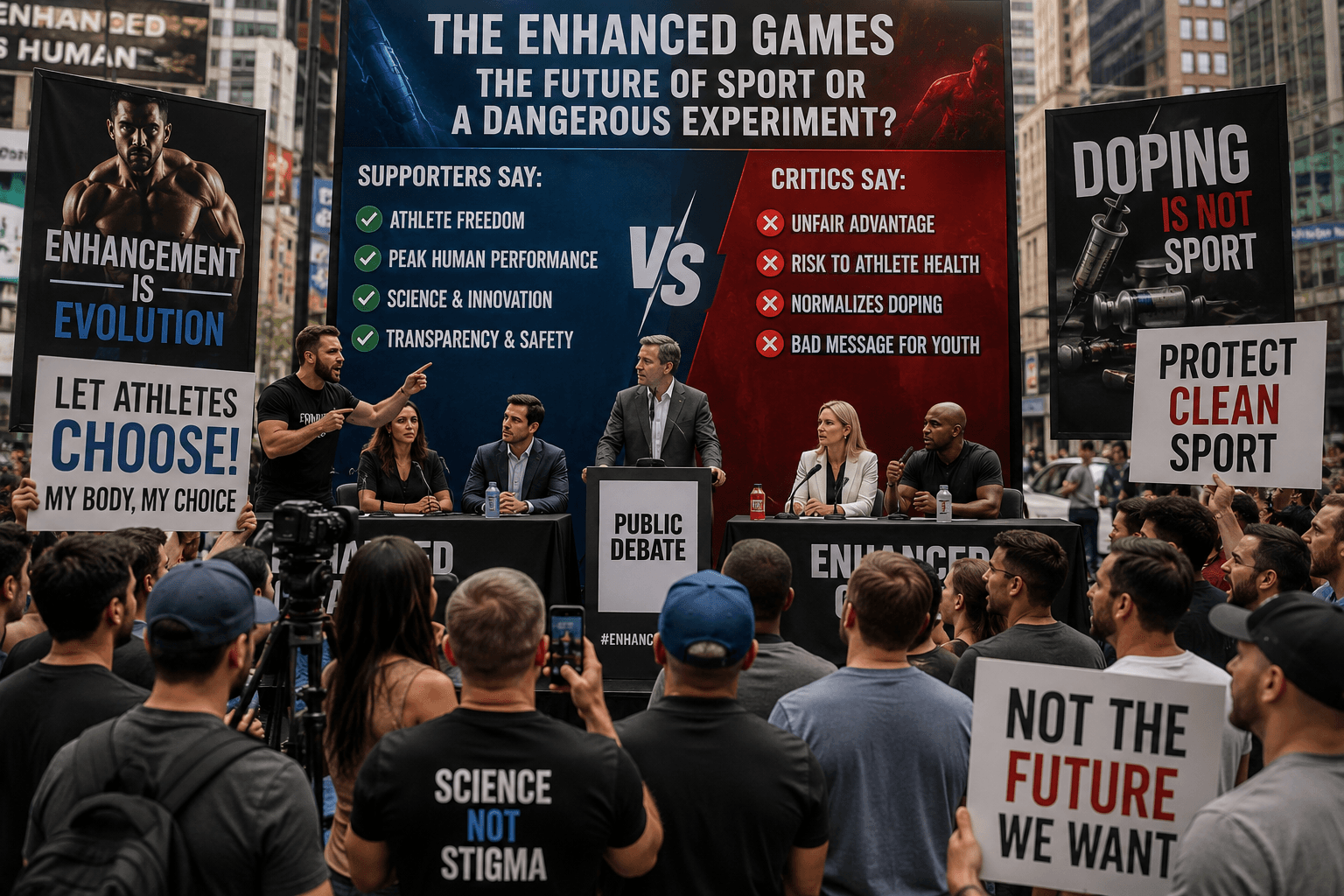
For a century, the Olympic motto "Citius, Altius, Fortius – Communiter" (Faster, Higher, Stronger – Together) has celebrated the pinnacle of natural human achievement. Doping has been the forbidden shadow, a threat to the purity of sport, relentlessly pursued by anti-doping agencies with ever-more-sophisticated testing. Now, a radical counter-movement is shattering that paradigm: the Enhanced Games, widely dubbed the "Steroid Olympics," openly invite athletes to use any pharmacological or technological enhancement they choose. This is not a secret underground competition; it is a well-funded, publicly announced event that forces sport to confront an uncomfortable question—if everyone is doping, and it's done under medical supervision, is the playing field finally level?
As a sports nutritionist and performance researcher who has spent decades navigating the gray areas of supplementation and recovery, I find the Enhanced Games both fascinating and deeply troubling. This guide will dissect the movement from every angle. You will learn the science behind the drugs athletes would use, the medical protocols the organizers propose to minimize harm, the ethical arguments tearing through locker rooms and academic halls, and what this might mean for the future of every sport from weightlifting to track and field. We will not cheerlead, and we will not condemn without evidence. Instead, we will equip you with the knowledge to form your own informed opinion on the most disruptive idea in athletic history.
The Genesis of the Enhanced Games: Why a "Drug Olympics" Now?
The Enhanced Games were conceived not by a rogue athlete, but by entrepreneurs and investors who see the endless cat-and-mouse game of doping control as a failed war. The premise is brutally simple: anti-doping efforts catch perhaps 1-2% of cheats, while sophisticated state-sponsored programs and private labs routinely beat the tests. This creates a "tyranny of the innocent," where clean athletes lose to silent, undetected pharmacology. The Enhanced Games proposition flips the script entirely: legalize and regulate enhancement, replace covert needles with transparent medical records, and claim that safety, not morality, should govern sport. [1]
Behind this is Aron D'Souza, an Australian businessman who frames the Games as a human rights movement for athlete bodily autonomy. The organization has secured millions in venture capital, attracted advisors from the biotech world, and announced plans for events in track, swimming, weightlifting, and combat sports, with the first edition slated for 2025. The core philosophy hinges on the belief that the pursuit of human enhancement is inevitable and that sport can either resist and become irrelevant or adapt and lead the science of human performance. [2] This philosophy taps into transhumanist ideas where technology and biology merge, but its critics argue it commercializes self-destruction for entertainment. To understand the true stakes, we must first examine the actual drugs that would define such a competition.
The Pharmacological Armory: What Would Athletes Use?
If the Enhanced Games removes all restrictions, the menu of performance-enhancing substances expands from classic anabolic steroids to cutting-edge gene therapies. An honest discussion requires moving past moral panic and into the clinical mechanisms, performance benefits, and documented risks of each class. The following table summarizes the key categories, but a deeper dive into the science is essential to grasp both the allure and the danger.
| Substance Class | Mechanism | Performance Benefit | Major Documented Risks |
|---|---|---|---|
| Anabolic Androgenic Steroids (Testosterone, Nandrolone, Trenbolone) | Bind androgen receptor, increase protein synthesis, satellite cell activation | Dramatic gains in muscle mass, strength, and recovery speed | HPTA suppression, cardiovascular disease, hepatotoxicity, psychiatric effects |
| Erythropoietin (EPO) & Hypoxia-Inducible Factor (HIF) Activators | Stimulate red blood cell production, increase oxygen-carrying capacity | Enhanced endurance, VO2max improvement up to 10-15% | Blood hyperviscosity, thrombosis, stroke, hypertension |
| Growth Hormone (hGH) & IGF-1 | Promote tissue growth, collagen synthesis, lipolysis | Improved recovery, potential lean mass increase, injury repair | Acromegaly, insulin resistance, cardiomegaly, increased cancer risk |
| Selective Androgen Receptor Modulators (SARMs) | Tissue-selective androgen receptor activation | Muscle growth with fewer androgenic side effects (in theory) | Testosterone suppression, hepatotoxicity, unknown long-term effects |
| Beta-2 Agonists (Clenbuterol, Salbutamol in high doses) | Increase metabolic rate, promote lipolysis, mild anabolic effect | Fat loss, preservation of lean mass during cutting | Tachycardia, cardiac hypertrophy, tremors, electrolyte imbalance |
| Myostatin Inhibitors (Follistatin, gene therapy vectors) | Block myostatin, the natural brake on muscle growth | Profound muscle hypertrophy, potentially unlimited growth capacity | Unknown long-term effects, potential cardiac hypertrophy, immune response to vectors |
Anabolic Steroids: The Foundation of Enhanced Performance
Testosterone and its synthetic derivatives remain the cornerstone of any doping regime aimed at strength and power. When combined with adequate nutrition and training, supraphysiological doses of testosterone can increase lean body mass by 5-10 kg over 10-20 weeks, even without exercise, and far more when paired with resistance training. [3] The molecular basis is the activation of androgen receptors in muscle and satellite cells, leading to increased protein synthesis and myonuclear donation. However, this pharmacological storm does not discriminate; it affects the cardiovascular system, causing adverse lipid profiles (elevated LDL, suppressed HDL), endothelial dysfunction, and left ventricular hypertrophy. The oft-cited long-term study of powerlifters who abused steroids showed a 4.6-fold increase in cardiovascular mortality compared to non-using athletes. [4]
In an Enhanced Games environment, athletes might cycle "designer" compounds like trenbolone, prized for its non-aromatizing, highly anabolic profile, but associated with severe neurotoxicity and kidney damage. The promise of medical supervision in such a context would be strained to the limit, as no amount of monitoring can nullify the inherent cardiotoxicity of permanent supraphysiological androgen exposure.
EPO and Blood Doping: The Endurance Frontier
For endurance athletes, the key limit is oxygen delivery. Recombinant human EPO revolutionized doping in the 1990s by boosting hematocrit from a typical 42-45% to 55% or beyond, leading to a 6-10% increase in time-trial performance. The risk, tragically illustrated by the deaths of several cyclists in the late 80s, is that excessively thick blood can cause fatal clotting, stroke, or heart attack, especially during the dehydration of competition. [5] The Enhanced Games organizers propose real-time blood viscosity monitoring, and argue that controlled EPO micro-dosing, combined with regular blood-letting and plasma expanders, could maintain hematocrit within a "safe" window while still providing benefit. This is highly speculative; the therapeutic window is narrow and individually variable, and the cumulative endothelial damage from chronic red cell excess is not well understood.
Growth Hormone and IGF-1: Repair, Not Just Size
Growth hormone's reputation as a bodybuilding miracle drug is largely myth; its direct anabolic effect on muscle is modest. Instead, it excels at accelerating connective tissue repair and reducing injury recovery time. However, when combined with anabolic steroids, the synergy can be profound. Long-term GH excess mimics acromegaly, leading to jaw growth, organ enlargement, and a markedly increased risk of colorectal cancer. [6] The idea that an enhanced athlete could safely use GH for years under supervision ignores the insidious nature of these effects, which emerge over decades.
Medical Supervision: Harm Reduction or Enabling Danger?
The Enhanced Games' most potent rhetorical weapon is the claim that transparency and medical oversight transform doping from a hidden pathology into a managed practice. According to their released protocols, participating athletes would undergo comprehensive pre-competition screening (echocardiogram, full blood panel, genetic testing for thrombophilia), and would be required to work with a dedicated physician who monitors biomarker safety windows. The organizing body argues this is the same principle as needle exchange programs or supervised injection sites: people will use drugs anyway, so provide the safest possible environment.
Yet medical ethicists have pushed back forcefully. The World Medical Association and many sport medicine bodies maintain that prescribing PEDs to healthy athletes for performance alone violates the fundamental tenet of "first, do no harm." Even with monitoring, physicians would be complicit in administering substances that cause known, irreversible harm over time, for the purpose of entertainment and profit. [7] There is also the grim historical parallel of the East German doping program, where state-appointed doctors systematically administered androgens to young athletes, causing lifelong health catastrophes, under the guise of "supervision." The crucial difference, proponents counter, is informed adult consent. But in the high-stakes, financially stratified world of elite sport, consent is rarely entirely free.
Medical Reality Check: No amount of blood testing can prevent the long-term consequences of chronic, high-dose steroid use—hepatocellular carcinoma, cardiomyopathy, and neuropsychiatric degeneration are probabilistic, not deterministic. The Enhanced Games' medical model may reduce acute risks like thrombotic events, but it does not, and cannot, make doping safe.
The Ethical Debate: Freedom, Fairness, and the Soul of Sport
The Enhanced Games have ignited a philosophical firestorm that goes far beyond the usual doping discussions. Three key moral arguments dominate the discourse.
1. The Autonomy Argument
At the core of the pro-Enhancement position is a libertarian ideal: what an adult athlete does with their body is their own sovereign choice. If an informed person accepts the risks in exchange for glory, prize money, or personal achievement, society has no right to prohibit it. This position aligns with broader bioethical shifts toward patient autonomy and away from medical paternalism. It also highlights the hypocrisy of allowing legal, dangerous sports (boxing, MMA, downhill skiing) while banning pharmacological risks. If we accept that athletes can risk traumatic brain injury for entertainment, why do we draw the line at a controlled EPO dose? [8]
2. The Fairness and Coercion Argument
The counter-argument is that legalization does not level the playing field—it tilts it violently toward those with the best access to the most advanced pharmacology, or the greatest willingness to take extreme risks. A young athlete from a developing nation, who might have natural genetic gifts, could never compete against a wealthy Western competitor with a personalized gene-doping cocktail. The pressure to dope would become insurmountable; "freely chosen" enhancement becomes a requirement to participate, effectively coercing all athletes to drug themselves to remain competitive. This, opponents argue, destroys the very concept of sport as a test of human character and natural endowment. [9]
3. The Message to Youth and Society
Sport is a powerful cultural signal. When the world's best athletes openly inject themselves to win, the message trickles down to teenagers in gyms, where body image disorders and anabolic steroid use are already at epidemic levels. A 2022 study found that non-medical anabolic steroid use among adolescent boys had tripled over the previous decade, driven partly by social media and body dysmorphia. [10] The Enhanced Games would amplify this trend, normalizing drug use for physical ideals, with a pediatric population uniquely vulnerable to permanent endocrine damage. This social externality, many ethicists argue, justifies prohibition even if adults choose freely.
| Dimension | Traditional Olympics (Clean Sport Model) | Enhanced Games (Open Model) |
|---|---|---|
| Core Principle | Natural human excellence, drug-free | Total human potential, enhanced by science |
| Doping Policy | Zero tolerance, WADA code, testing | No restrictions, transparent declaration |
| Medical Role | Treat injury, maintain health; report doping | Optimize drug protocols, monitor harm |
| Fairness Concept | Level playing field by forbidding PEDs | Level playing field by allowing all |
| Health Model | Protection from drug harm | Harm reduction within drug use |
| Public Health Message | Drugs are unnecessary for achievement | Open use, honest risk communication |
The Athlete's Perspective: Who Would Compete?
As of now, no current Olympic champion has publicly committed to the Enhanced Games, but several former athletes and controversial figures have expressed interest. The archetype is the athlete who has already been sanctioned for doping and sees the Games as redemption. James Magnussen, the Australian swimming champion, has reportedly agreed to come out of retirement to compete in an enhanced swimming event, claiming he wants to show what the human body is truly capable of when freed from arbitrary rules. [11] Other potential participants include athletes nearing retirement who feel they have no more "clean" records to break and see the Enhanced Games as a final, lucrative chapter.
Critics dismiss this as a circus of banned athletes and desperate veterans. Proponents argue that if the prize money reaches the promised $1 million per event, it will attract a new generation of openly enhanced athletes who train pharmacology alongside technique. The real question is whether a critical mass of talent can establish credibility, or if the event remains a freakshow, its records meaningless to a public that still values the myth of natural purity.
The Supplement and Nutrition Angle: Preparing the Enhanced Body
Even in an open doping environment, nutrition and legal supplements remain the substrate that makes drugs work. Anabolic steroids amplify protein synthesis, but without adequate amino acid intake—1.6-2.2 g/kg daily of high-quality protein—that amplified signal is wasted. The enhanced athlete still requires meticulous macronutrient periodization, micronutrient co-factors for liver detoxification (N-acetylcysteine, milk thistle, though evidence is mixed), and cardiovascular support supplements like omega-3 fatty acids (3-5g EPA/DHA) to partially mitigate lipid derangement. Creatine monohydrate, already the most effective legal ergogenic aid, becomes even more powerful when layered on androgens, as increased work capacity in training translates directly to greater muscle adaptation. [12]
This underscores a crucial point: pharmacology does not replace the fundamentals; it multiplies them. An athlete who takes the most exotic stack but sleeps 4 hours a night, eats processed food, and ignores recovery will still be destroyed by a disciplined, well-nourished athlete on a fraction of the drug dose. The Enhanced Games would not be a shortcut; it would be the most scientifically demanding athletic endeavor in history, requiring expertise in exercise physiology, pharmacology, and clinical monitoring simultaneously.
Myths and Misconceptions About the Enhanced Games
Myth 1: "PEDs Do All the Work; Enhanced Athletes Don't Train Hard"
This is perhaps the most pervasive and insulting myth. Elite athletes on PEDs train with extraordinary intensity and volume. Drugs allow them to recover from workloads that would crush a natural athlete, but they do not generate performance from thin air. The Enhanced Games would still reward the most disciplined, genetically gifted, and hardest-working individuals; the drugs simply shift the ceiling upward.
Myth 2: "With Medical Supervision, Doping Becomes Safe"
Medical supervision can make doping less acutely dangerous, but not safe. The long-term carcinogenic and cardiovascular risks are dose- and duration-dependent, and no amount of monitoring eliminates them. Safety is a relative term; supervised boxing is still traumatic. The Enhanced Games can reduce the hazard of an air bubble in a syringe or a grossly elevated hematocrit, but they cannot protect against the myocardial fibrosis that appears on autopsy in long-term steroid users.
Myth 3: "Records Will Be Shattered Overnight"
Performance improvements from drugs, while significant, are bounded. Steroid-era sprinting times in the 1980s were not dramatically faster than modern times, thanks to advances in nutrition and training that partially close the gap. The Enhanced Games would likely see world records fall, but by marginal percentages, not quantum leaps. The limits of human physiology, even when pharmacologically supported, remain formidable.
Coach's Insight: Whether you support the Enhanced Games or not, the conversation forces a valuable reflection on what you really train for. Is it the external validation of beating others, or the internal pursuit of your own physical and mental edge? The doping debate obscures a simpler truth: the daily discipline of training, nutrition, and recovery is the most powerful performance enhancer for 99% of us, and it requires no prescription.
Frequently Asked Questions
Is the Enhanced Games actually happening?
Yes. The organization has publicly announced plans for a multi-sport event in 2025, with significant venture capital backing. While there is skepticism about logistical and legal hurdles, the momentum behind the event is real, and some athletes have committed.
Would the Enhanced Games be legal in any country?
Legality depends on jurisdiction. In many countries, possession and distribution of anabolic steroids and EPO without a prescription are criminal offenses. The Enhanced Games cannot supersede national drug laws. Likely, the event would be hosted in a country with lax enforcement or would seek a legal exemption. Athletes could still face criminal charges upon returning home. This legal minefield remains the biggest practical obstacle.
How would records be validated?
The organizers propose that all records would be public and carry an "Enhanced" designation. There would be no attempt to compare directly to traditional Olympic marks. The Enhanced Games would maintain their own record books, effectively creating a parallel sporting universe. Whether the public will respect these records as equivalent remains to be seen.
What about the risk of death during competition?
The acute risk of death, particularly from cardiac events related to EPO or stimulants, is the organizers' greatest fear. They claim that mandatory real-time biometric monitoring and strict pre-competition screening will prevent such tragedies, but no protocol can eliminate risk. The first death at an Enhanced Games would be an existential threat to the entire project, and critics argue it is not a matter of if, but when.
Could this lead to two separate Olympic movements?
Possibly. The International Olympic Committee has been unequivocal in its condemnation, and any athlete who participates in the Enhanced Games would face a lifetime ban from traditional competition. This creates a stark binary choice, and the downstream effect could be a bifurcation of sport into "natural" and "enhanced" leagues, similar to how bodybuilding split into tested and untested federations. The cultural and financial consequences of such a split would reshape the entire athletic landscape.
Conclusion: The Line We Will All Have to Draw
The Enhanced Games are not a passing stunt. They are the logical, provocative endpoint of a century-long tension between athletic aspiration and human biology. They force us to ask uncomfortable questions: If we truly valued athlete health above all, would we ban American football? If we accepted enhancement, could we channel it into safer, more transparent practices, or would we unleash an arms race that consumes its participants? There are no easy answers, only trade-offs between liberty, safety, fairness, and the meaning we assign to sport.
As a coach and researcher, I remain rooted in the belief that the vast majority of athletes, at every level, can achieve extraordinary things without pharmacology, through intelligent training, nutrition, and recovery. The Enhanced Games represent a choice that every athlete, and every fan, will now have to confront. Before you take a position, educate yourself on the science, speak to medical professionals, and examine what you believe sport is ultimately for. The conversation has only just begun, and it will define the next generation of human performance.
For more evidence-based analysis on sports performance, ethics, and health, explore our library of in-depth guides. The future of your performance—and the future of sport—deserves nothing less than rigorous, honest inquiry.
References
- D'Souza, A. "The Enhanced Games: Redefining athletic competition through science and transparency." Enhanced Games Official Statement (2023).
- Savulescu, J. et al. "Why we should allow performance enhancing drugs in sport." British Journal of Sports Medicine, vol. 38, no. 6, 2004, pp. 666-670.
- Bhasin, S. et al. "The effects of supraphysiologic doses of testosterone on muscle size and strength in normal men." New England Journal of Medicine, vol. 335, no. 1, 1996, pp. 1-7.
- Pärssinen, M. et al. "Increased premature mortality of competitive powerlifters suspected to have used anabolic agents." International Journal of Sports Medicine, vol. 21, no. 3, 2000, pp. 225-230.
- Lundby, C. et al. "Does recombinant human Epo increase exercise capacity by means other than augmenting oxygen transport?" Journal of Applied Physiology, vol. 105, no. 2, 2008, pp. 581-587.
- Melmed, S. "Acromegaly pathogenesis and treatment." Journal of Clinical Investigation, vol. 119, no. 11, 2009, pp. 3189-3202.
- World Medical Association. "WMA Statement on Performance-Enhancing Drugs in Sport." Adopted by the 68th WMA General Assembly, 2017.
- Kayser, B. et al. "Current anti-doping policy: a critical appraisal." BMC Medical Ethics, vol. 8, no. 2, 2007.
- Murray, T. H. "The coercive power of drugs in sports." Hastings Center Report, vol. 13, no. 4, 1983, pp. 24-30.
- Pope, H. G. et al. "The prevalence of anabolic-androgenic steroid use among American adolescents: recent trends and clinical implications." American Journal of Men's Health, vol. 16, no. 3, 2022, pp. 155798832210958.
- Magnussen, J. "Why I'm returning for the Enhanced Games." Athletes' Voice, 2024.
- Kreider, R. B. et al. "International Society of Sports Nutrition position stand: safety and efficacy of creatine supplementation in exercise, sport, and medicine." Journal of the International Society of Sports Nutrition, vol. 14, no. 18, 2017.
- Lippi, G. et al. "Doping in sports: a medical perspective." The Lancet, vol. 365, no. 9465, 2005, pp. S14-S15.
- Saugy, M. et al. "The athlete biological passport: a new weapon in the fight against doping." Swiss Medical Weekly, vol. 140, 2010, pp. w13074.
- Handelsman, D. J. "Mechanisms of action of testosterone—unraveling the Gordian knot." New England Journal of Medicine, vol. 369, no. 11, 2013, pp. 1058-1059.
- Baume, N. et al. "The athlete biological passport: an effective tool in the fight against doping." Clinical Chemistry, vol. 57, no. 7, 2011, pp. 939-948.
- Duntas, L. H. et al. "Doping: the endocrine perspective." Hormones, vol. 10, no. 3, 2011, pp. 223-232.
- WADA. "World Anti-Doping Code." World Anti-Doping Agency, 2021.
Share